
Producing high-quality content at scale remains one of the biggest challenges for marketers in 2026. While 85% of marketers use AI tools for content creation, many struggle to maintain quality and originality in their outputs. This guide walks you through a proven step-by-step process to create AI content that drives results, from preparation and prompt engineering to verification and performance tracking.
Table of Contents
- Understanding the AI content creation challenge
- Preparing to create AI content: essential tools and mindset
- Executing AI content creation: step-by-step process
- Verifying and refining AI content for quality and impact
- Enhance your AI content creation with Sofia🤖
- FAQ
Key takeaways
| Point | Details |
|---|---|
| AI boosts productivity | AI content creation significantly increases marketing output and efficiency when used strategically |
| Quality inputs matter | Prompt engineering and high-quality data sources are critical to producing valuable AI content |
| Human editing required | Always include rigorous human review to ensure accuracy, brand voice, and reader value |
| Track performance | Monitor conversion rates and SEO impact to continuously improve your AI content strategy |
| Strategic implementation | AI tools work best when aligned with clear goals, audience needs, and quality standards |
Understanding the AI content creation challenge
The promise of AI content creation sounds incredible. Generate blog posts in minutes, scale your content library exponentially, and free up time for strategic work. Yet many marketers find themselves disappointed with the results.
The reality is that most AI-generated long-form content currently on the internet is garbage. High volume output often sacrifices depth, originality, and genuine usefulness. Articles read like they were written by committee, lacking the insights and practical value that actually convert readers into customers.
"Most AI-generated long-form content currently on the internet is garbage."
This quality problem stems from three common mistakes. First, marketers rush to generate content without proper preparation or clear objectives. Second, they use generic prompts that produce generic results. Third, they skip the crucial human editing phase that transforms adequate AI drafts into compelling, accurate content.
Understanding these pitfalls is essential before you start creating AI content yourself. The good news is that with the right approach, you can leverage tools like an AI-powered personal assistant to produce content that genuinely serves your audience while dramatically improving your efficiency.
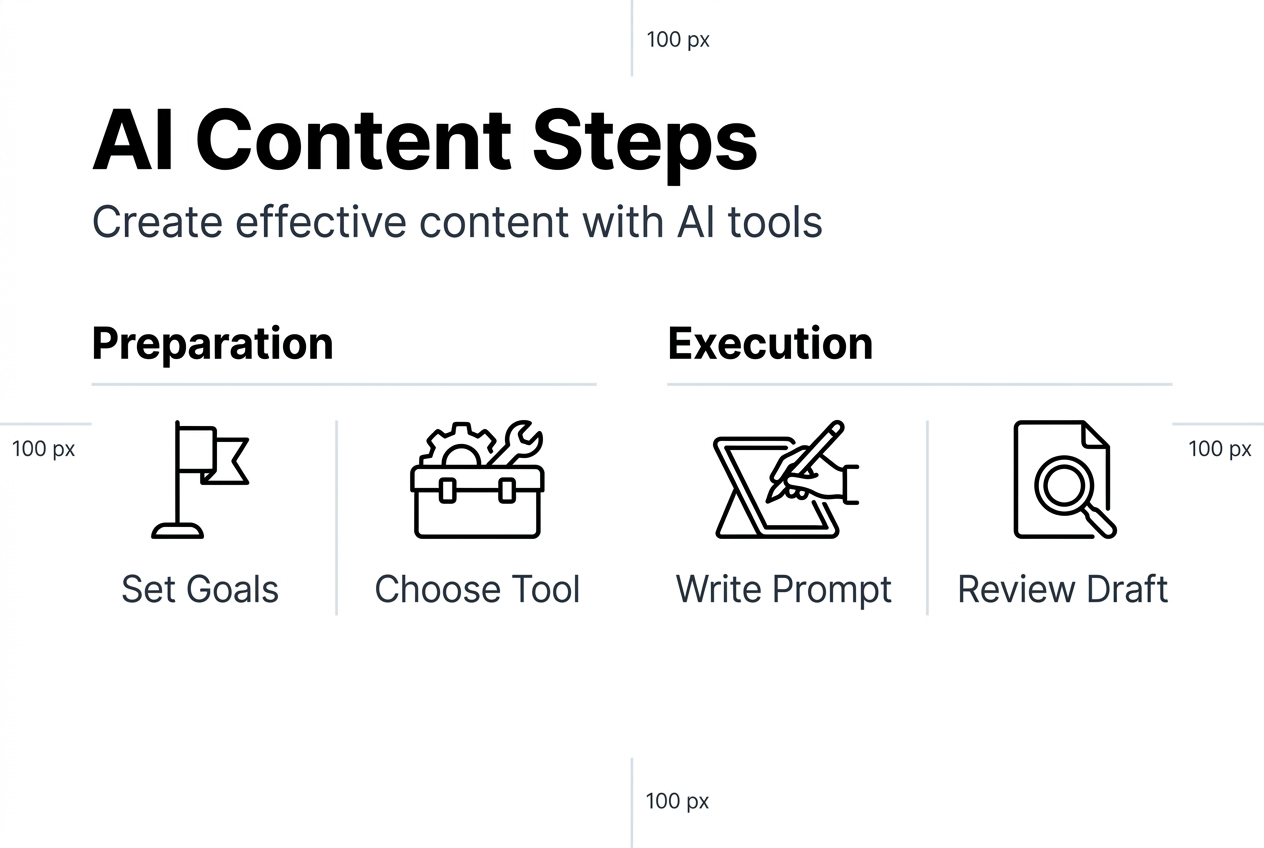
The key is treating AI as a powerful collaborator rather than a replacement for human creativity and expertise. When you combine strategic planning, quality inputs, and thorough editing, AI content becomes a competitive advantage rather than a liability.
Preparing to create AI content: essential tools and mindset
Successful AI content creation starts long before you type your first prompt. Your preparation phase determines whether you'll produce valuable content or add to the pile of mediocre AI writing cluttering the internet.
Start by selecting AI content tools that align with your specific goals and workflow. With 85% of marketers using AI tools for content creation in 2026, the market offers countless options. Evaluate platforms based on their model capabilities, integration with your existing tools, and ability to maintain brand voice consistency.
Next, gather high-quality data sources to inform your AI outputs. The principle is simple: garbage in, garbage out. The effectiveness of AI content generation is highly dependent on the quality of training data and prompt engineering used. Collect your best-performing content, customer research, industry reports, and competitive analysis to feed into your AI workflow.
Essential preparation checklist:
- Define clear content objectives tied to business metrics
- Gather high-quality source materials and data
- Document your brand voice guidelines and style preferences
- Identify target keywords and search intent for each piece
- Set specific quality standards and review criteria
- Choose AI tools that match your technical capabilities
Prompt engineering deserves special attention. This skill separates mediocre AI content from exceptional results. Learn to write prompts that specify audience, tone, structure, key points, and constraints. The more detailed and strategic your prompts, the better your outputs.
Pro Tip: Create a prompt template library for different content types. Include sections for audience description, desired outcomes, tone guidelines, structural requirements, and examples of your best content. This saves time and ensures consistency across all AI-generated pieces.
| Preparation Element | Impact on Quality | Time Investment |
|---|---|---|
| Prompt engineering | Very High | Medium |
| Source data quality | Very High | High |
| Tool selection | Medium | Low |
| Brand guidelines | High | Medium |
| Quality standards | High | Low |
Finally, adopt the right mindset. View AI as a collaborative tool that handles research, initial drafting, and structure while you provide strategic direction, creativity, and final polish. An AI-powered personal assistant can streamline this collaboration by managing multiple aspects of your content workflow in one platform.
With thorough preparation complete, you're ready to execute your AI content creation process with confidence.
Executing AI content creation: step-by-step process
Now you're ready to generate AI content that actually delivers value. Follow this systematic process to create drafts that require minimal editing while maintaining quality and originality.
Step 1: Define goals and target audience clearly

Start every piece by documenting exactly who you're writing for and what action you want them to take. Specify demographic details, pain points, knowledge level, and decision-making stage. This clarity shapes everything that follows.
Step 2: Craft thoughtful prompts incorporating keywords and constraints
Your prompt is your content blueprint. Include target keywords naturally, specify word count ranges, outline required sections, and provide examples of your preferred style. The more specific you are, the less editing you'll need later.
Step 3: Generate AI content drafts using chosen tools
Run your prompt through your selected AI platform. With 88% of marketers using AI in their day-to-day roles, you're in good company. Generate multiple variations if time allows, as this gives you options to combine the best elements from each draft.
Step 4: Conduct an initial quality and relevance review
Read through the generated content quickly to assess whether it addresses your objectives and maintains your brand voice. Check for obvious factual errors, awkward phrasing, or sections that drift off topic. This quick scan helps you decide whether to refine your prompt and regenerate or move forward with editing.
Pro Tip: Keep a swipe file of your most successful AI-generated content along with the prompts that created it. Reference these when tackling similar content types to accelerate your process and maintain consistency.
| Process Step | Key Actions | Success Indicators |
|---|---|---|
| Goal definition | Document audience and objectives | Clear, measurable outcomes |
| Prompt crafting | Include keywords, structure, examples | Specific, detailed instructions |
| Content generation | Create multiple draft variations | On-topic, structured output |
| Initial review | Check relevance and accuracy | Minimal off-topic content |
The execution phase moves quickly once you've established your workflow. An AI personal assistant platform can help you manage multiple content projects simultaneously while maintaining quality standards across all outputs.
Remember that your first draft is just that, a draft. The real magic happens in the refinement phase where human expertise transforms good AI content into great content that drives results.
Verifying and refining AI content for quality and impact
Generation is only half the battle. The verification and refinement phase separates content that converts from content that bounces. This is where you add the human expertise and insight that AI cannot replicate.
Start with thorough human editing for factual accuracy and style consistency. Read every sentence critically. Verify statistics and claims against original sources. Check that examples and recommendations actually make sense for your target audience. AI can hallucinate facts or provide outdated information, so treating every claim as potentially incorrect until verified is essential.
Critical editing checklist:
- Verify all statistics and factual claims against authoritative sources
- Ensure brand voice and tone match your style guidelines
- Remove repetitive phrases and awkward transitions
- Add specific examples and actionable insights
- Strengthen headlines and subheadings for clarity
- Eliminate generic advice in favor of unique perspectives
Optimize AI content for SEO and user intent next. Ensure your target keywords appear naturally in strategic locations like headings, the first paragraph, and throughout the body. More importantly, confirm the content genuinely satisfies the search intent behind those keywords. Google's algorithms in 2026 are sophisticated enough to recognize when content uses keywords without providing real value.
Implement A/B testing to measure performance gains objectively. One case study demonstrated that conversion rates improved 30%, from 2.0% to 2.6% CTR in A/B tests using refined AI content. Test different headlines, introductions, and calls to action to identify what resonates best with your audience.
Track AI visibility and brand impact over time using comprehensive monitoring. As one successful implementation showed, the work started with a baseline audit and ongoing monitoring to measure improvements. Monitor search rankings, organic traffic, engagement metrics, and conversion rates specifically for AI-generated content compared to human-written pieces.
"Conversion rates improved 30%, from 2.0% to 2.6% CTR in A/B tests using refined AI content."
Pro Tip: Create a quality scoring rubric with specific criteria like factual accuracy, originality, actionability, and reader engagement. Score each piece before and after editing to quantify your improvement process and identify patterns in what needs the most refinement.
The verification phase is where you prove whether your AI content strategy actually works. Tools like AI content monitoring tools help you track performance across all your AI-generated pieces, making it easier to identify successful patterns and areas needing improvement.
Continuous measurement and refinement turn AI content creation from an experiment into a reliable system for scaling your marketing efforts while maintaining quality.
Enhance your AI content creation with Sofia🤖
Creating high-quality AI content at scale requires more than just a good language model. You need integrated tools that support your entire workflow from planning through monitoring.
Sofia🤖 brings together over 60 state-of-the-art AI models from providers like GPT-4o, Claude 4.0, and Gemini 2.5 in a single platform designed for content creators and marketers. Access advanced prompt engineering capabilities, document analysis for research, and real-time collaboration features that streamline your content production process.
The platform's team collaboration tools let you assign content tasks, track revisions, and maintain consistent quality standards across all team members. Combine data-driven insights with human creativity to produce content that genuinely serves your audience while dramatically improving efficiency. Explore how an AI-powered personal assistant can transform your content marketing strategy.
FAQ
What are the best AI tools for content creation?
Popular tools include OpenAI's GPT models, Claude, Jasper, and integrated platforms that combine multiple AI capabilities. Choose tools based on your specific content needs, budget, and technical requirements. The best solution offers strong model performance, easy integration with your workflow, and features like prompt templates and quality monitoring.
How can I ensure AI content is high quality?
Focus on crafting detailed, strategic prompts that specify audience, tone, structure, and key points you want covered. Always include rigorous human editing before publishing to verify facts, improve flow, and add unique insights AI cannot provide. Set clear quality standards and score each piece against specific criteria like accuracy, originality, and actionability.
Does AI content help with SEO?
AI content can significantly boost SEO when properly optimized for keywords and search intent. One case study showed AI content optimization improved search rankings from position 8 to 5, demonstrating measurable SEO benefits. The key is ensuring AI-generated content genuinely satisfies user intent rather than just including keywords. Monitor performance metrics to continuously refine your approach.
How much editing does AI content typically need?
The editing requirement varies based on your prompt quality and content complexity. Well-crafted prompts with quality source data might need only 20-30% editing focused on verification and voice refinement. Generic prompts or complex technical topics may require 50-70% rewriting. Track your editing time across projects to identify patterns and improve your prompting skills over time.
Can AI content maintain brand voice consistency?
Yes, when you provide clear brand guidelines and examples in your prompts. Include specific tone descriptors, sample sentences demonstrating your voice, and words or phrases to avoid. Creating custom AI profiles with your brand voice trained into the model further improves consistency. Regular quality audits ensure all AI-generated content aligns with your established brand standards.