
Business professionals face a constant challenge: selecting AI solutions that genuinely improve productivity and accelerate decision-making. With countless AI platforms promising transformation, distinguishing impactful technologies from overhyped tools becomes critical. Real-time AI offers distinct advantages over traditional AI approaches, delivering immediate insights and responsive workflows that adapt to changing business conditions. This article explores evidence-backed benefits of real-time AI, evaluation criteria for selecting solutions, and practical strategies to overcome implementation challenges while maximizing operational efficiency.
Table of Contents
- How To Evaluate AI Solutions: Key Criteria For Real-Time Performance
- Top Advantages Of Real-Time AI In Business Workflows
- The Technology Behind Real-Time AI: Integration And Processing Frameworks
- Balancing Speed And Accuracy: Limitations And Mitigations In Real-Time AI
- Explore Sofia🤖: Your AI-Powered Personal Assistant For Real-Time Insights
- Frequently Asked Questions About Real-Time AI Advantages
Key takeaways
| Point | Details |
|---|---|
| Reduced latency accelerates decisions | Real-time AI processes data in milliseconds, enabling faster business responses |
| Enhanced accuracy improves reliability | Systems achieve 99.99% data accuracy, strengthening decision quality |
| Live data integration boosts responsiveness | Connecting multiple real-time sources creates adaptive workflows |
| Operational efficiency cuts downtime | Self-healing systems and predictive caching minimize disruptions |
| Manageable limitations with proven mitigations | Latency challenges and bias risks are addressable through advanced frameworks |
How to evaluate AI solutions: key criteria for real-time performance
Selecting the right AI solution requires understanding what separates effective real-time systems from conventional alternatives. Latency, the delay between input and output, determines whether your AI can support time-sensitive decisions. Systems with high latency create bottlenecks that slow workflows and frustrate users. Look for platforms demonstrating sub-second response times in production environments.
Data quality directly impacts decision reliability. Real-time AI must process accurate, current information to generate trustworthy insights. Evaluate how solutions validate incoming data, handle errors, and maintain consistency across sources. Systems that integrate multiple live data streams without compromising accuracy deliver superior value for complex business scenarios.
Operational resilience separates robust platforms from fragile ones. Your AI solution should minimize downtime through self-healing capabilities and redundant architecture. Consider how systems recover from failures, balance workloads during peak demand, and maintain performance under stress. Privacy and compliance matter equally when processing live data. Verify that platforms meet GDPR requirements and industry-specific regulations while protecting sensitive information.
When assessing AI-powered personal assistant platforms, prioritize these evaluation criteria:
- Response time under realistic load conditions
- Data validation mechanisms and error handling
- Integration capabilities with existing data sources
- System monitoring and automated recovery features
- Security certifications and compliance documentation
Pro Tip: Request benchmark data showing actual latency measurements during peak usage periods, not just theoretical maximums. Real-world performance often differs significantly from lab conditions.
Top advantages of real-time AI in business workflows
Real-time AI transforms business operations through measurable performance improvements. Advanced systems achieve sub-5ms latency and 99.99% accuracy, enabling decisions that would be impossible with traditional batch processing. This speed advantage compounds across workflows, turning small time savings into substantial productivity gains.

Consider the impact on employee effectiveness. When Repsol implemented AI-driven workflows, output quality jumped 16.2% while saving each employee 121 minutes weekly. These aren't marginal improvements. They represent fundamental shifts in how work gets done, freeing professionals to focus on strategic thinking rather than routine processing.
Competitive advantages emerge from faster decision cycles. Organizations using real-time AI respond to market changes, customer needs, and operational issues before competitors recognize problems exist. This responsiveness creates opportunities that slower systems simply miss. Integration with existing data streams amplifies these benefits by eliminating manual data transfers and reducing errors.
The most significant advantages of real-time AI include:
- Immediate insight generation from live data sources
- Continuous accuracy improvements through adaptive learning
- Seamless workflow integration without disrupting existing processes
- Reduced operational costs through automated optimization
- Enhanced customer experiences via responsive interactions
Pro Tip: Start with high-impact, low-complexity workflows when implementing real-time AI. Quick wins build organizational confidence and demonstrate value before tackling more challenging applications.
Real-time AI platforms like AI-powered personal assistant solutions deliver these advantages through unified interfaces that simplify access to multiple AI models. Instead of managing separate tools for different tasks, professionals work within integrated environments that maintain context across activities.
The technology behind real-time AI: integration and processing frameworks
Understanding the technologies powering real-time AI helps you evaluate solutions effectively. Apache Kafka, Hadoop, and AI-powered optimization form the foundation of advanced systems, enabling zero-latency big data processing through intelligent workload balancing. These aren't just buzzwords. They represent proven architectures handling billions of events daily.
Apache Kafka manages data ingestion with ordered streams, while Apache Flink performs processing with exactly-once semantics and minimal latency. This combination ensures that data flows continuously without duplication or loss, critical for maintaining accuracy in real-time scenarios. Hadoop provides scalable storage and distributed computing power for handling massive datasets.
The choice between real-time and batch processing fundamentally shapes system capabilities:
| Processing Type | Latency | Use Cases | Complexity | | --- | --- | --- | | Real-time streaming | Milliseconds | Fraud detection, live monitoring, instant recommendations | Higher | | Batch processing | Hours to days | Historical analysis, periodic reporting, archival tasks | Lower | | Hybrid approach | Variable | Mixed workloads requiring both immediate and deep analysis | Moderate |
AI optimization techniques reduce latency through predictive caching, which anticipates needed data before requests arrive. Self-healing recovery mechanisms detect failures and reroute processing automatically, maintaining service continuity. These capabilities transform theoretical architectures into practical systems that deliver consistent performance.
Emerging edge computing solutions bring processing closer to data sources, particularly valuable in 5G environments where network latency dominates total response time. By distributing computation across edge nodes, systems reduce round-trip delays and improve responsiveness for mobile and IoT applications.
Key technologies enabling real-time AI include:
- Stream processing engines for continuous data analysis
- Distributed message queues for reliable event handling
- In-memory databases for ultra-fast data access
- Machine learning model optimization for reduced inference time
- Automated scaling systems that adjust resources dynamically
Pro Tip: Evaluate whether platforms support hybrid architectures combining real-time and batch processing. Many business scenarios benefit from both immediate responses and deeper periodic analysis.
Platforms like AI workflow automation platform solutions abstract these complexities, providing simple interfaces backed by sophisticated technology stacks. You gain real-time capabilities without managing infrastructure.
Balancing speed and accuracy: limitations and mitigations in real-time AI
Real-time AI delivers impressive benefits but faces genuine challenges requiring thoughtful mitigation. Latency and network limitations create delays in critical applications like fraud detection and autonomous vehicles, where milliseconds determine success or failure. Even well-designed systems struggle when network infrastructure introduces unpredictable delays.
Data quality issues and algorithmic bias remain significant concerns. Real-time systems process information so quickly that validation becomes challenging. Garbage in, garbage out applies with particular force when decisions happen instantly. Static training data limits AI effectiveness in dynamic environments, creating gaps between model knowledge and current reality. Models trained on historical patterns may miss emerging trends or changing conditions.
Privacy and compliance requirements add complexity to real-time implementations. Processing live data often involves personal information subject to strict regulations. Systems must balance speed with proper data handling, encryption, and access controls. This tension between performance and security requires careful architectural decisions.
Effective mitigation strategies address these limitations systematically:
- Implement multi-layer validation checking data quality at ingestion and processing stages
- Use ensemble models combining multiple algorithms to reduce individual bias
- Deploy continuous learning systems that update models with fresh data
- Establish compliance frameworks integrating privacy controls into processing pipelines
- Monitor system performance actively to detect and correct emerging issues
Advanced algorithms help balance speed and accuracy through techniques like approximate computing, which trades perfect precision for faster results when exactness isn't critical. Federated learning enables model improvements without centralizing sensitive data, addressing privacy concerns while maintaining performance.
Organizations succeeding with real-time AI recognize limitations as design constraints rather than insurmountable barriers. They build systems acknowledging imperfect information and uncertain conditions, incorporating human oversight for high-stakes decisions. This pragmatic approach delivers practical benefits while managing risks responsibly.
Platforms focused on handling real-time AI challenges incorporate these mitigations by default, reducing the burden on individual users to architect complex safeguards. Built-in validation, bias detection, and compliance tools make real-time AI accessible to organizations lacking specialized expertise.
Explore Sofia🤖: your AI-powered personal assistant for real-time insights
Now that you understand real-time AI advantages and implementation considerations, consider how Sofia AI assistant applies these benefits to everyday business challenges. Sofia🤖 combines over 60 state-of-the-art AI models into a unified platform, delivering the speed and accuracy discussed throughout this article without requiring technical expertise.
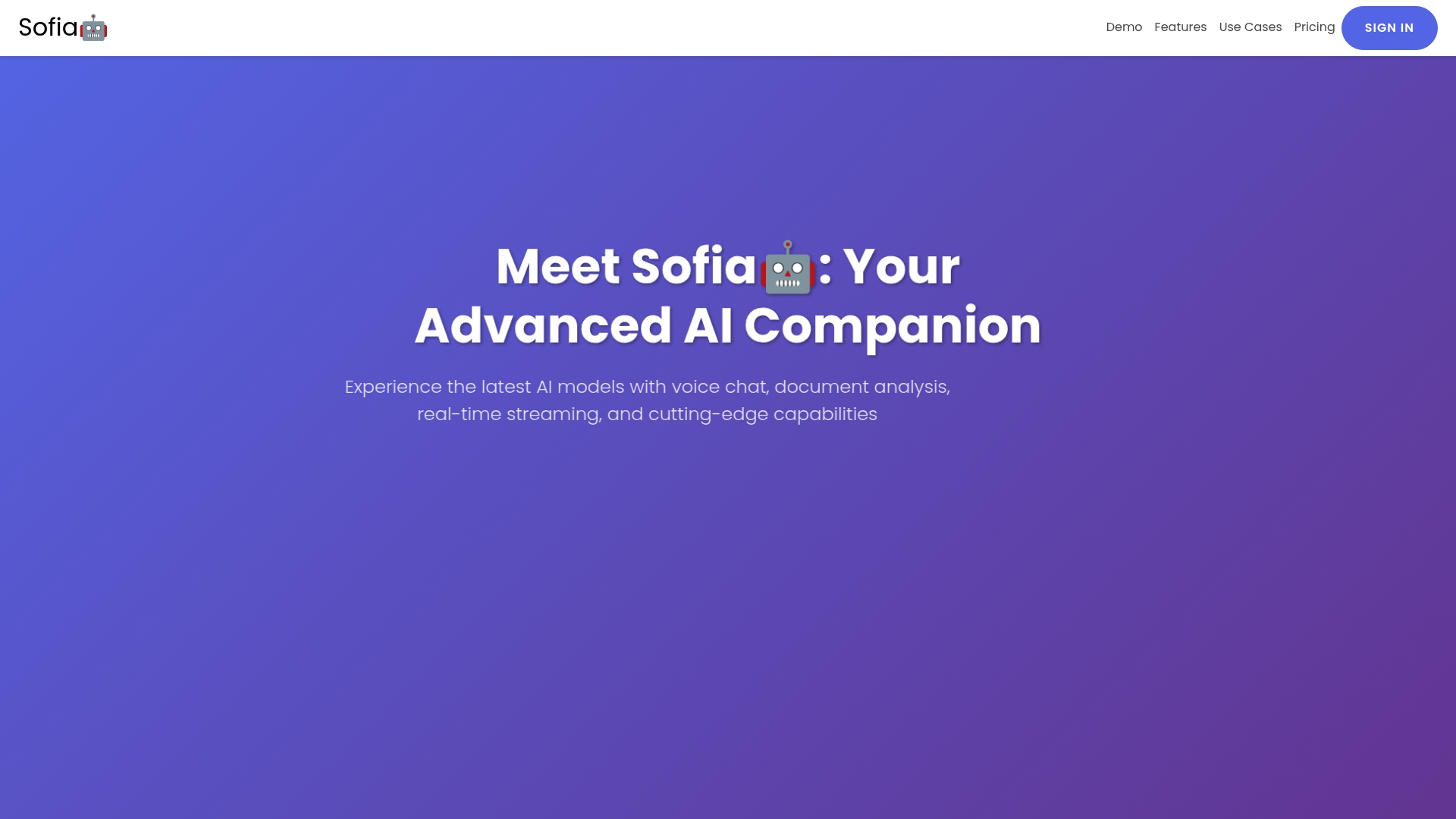
The platform handles document analysis, voice interactions, and team collaboration through real-time streaming responses that adapt to your workflow. Whether you're processing PDFs, generating insights from images, or coordinating with colleagues, Sofia🤖 maintains context across activities while protecting your data through enterprise-grade encryption and GDPR compliance. Experience how real-time AI assistant features transform productivity by trying Sofia🤖 today.
Frequently asked questions about real-time AI advantages
What distinguishes real-time AI from traditional AI?
Real-time AI processes data and generates responses within milliseconds, while traditional AI often uses batch processing with delays ranging from minutes to hours. This speed difference enables immediate decision-making and responsive workflows impossible with conventional approaches. Real-time systems also integrate live data sources continuously rather than working with static datasets.
How does real-time AI improve decision-making speed?
Real-time AI eliminates waiting periods between data collection and insight generation by processing information as it arrives. Systems analyze patterns, detect anomalies, and recommend actions instantly, allowing professionals to respond to situations while they're still developing. This acceleration compounds across multiple decisions throughout the day, dramatically improving overall responsiveness.
What industries benefit most from real-time AI?
Financial services leverage real-time AI for fraud detection and algorithmic trading. Healthcare uses it for patient monitoring and diagnostic support. Retail applies it to personalized recommendations and inventory optimization. Manufacturing employs it for predictive maintenance and quality control. Any industry where timely decisions create competitive advantage or prevent losses benefits significantly.
How is data privacy ensured in real-time AI systems?
Modern real-time AI platforms implement encryption for data in transit and at rest, access controls limiting who can view sensitive information, and compliance frameworks meeting GDPR and industry-specific regulations. Federated learning techniques enable model improvements without centralizing private data. Regular security audits and privacy impact assessments identify and address vulnerabilities. Explore further real-time AI resources to understand specific privacy implementations.
What are common challenges when adopting real-time AI?
Organizations frequently struggle with integrating real-time systems into existing infrastructure, ensuring data quality across multiple live sources, and managing the increased complexity of continuous processing. Skills gaps make finding professionals who understand streaming architectures difficult. Budget constraints limit investment in necessary infrastructure upgrades. Starting with focused pilot projects and selecting platforms that abstract technical complexity helps overcome these barriers.