
Many marketers believe AI-generated content is inherently generic and ineffective for SEO. This misconception overlooks how AI content optimization tools transform content performance when combined with strategic human oversight. AI-powered optimization workflows enhance search visibility, user engagement, and conversion rates by analyzing search patterns, optimizing entity relationships, and continuously refining content based on performance data. This guide explains proven methodologies, hybrid workflows, and quality safeguards that help content strategists leverage AI tools for measurable digital marketing improvements.
Table of Contents
- Key takeaways
- Understanding AI-driven content optimization workflows
- Core methodologies and best practices for AI content optimization
- Balancing AI automation and human expertise for optimal results
- Addressing AI limitations and ensuring content quality and compliance
- Accelerate your content optimization with advanced AI tools
- Frequently asked questions about AI content optimization
Key Takeaways
| Point | Details |
|---|---|
| Hybrid AI human workflow | Combining AI driven optimization with human oversight boosts traffic and conversions through smarter content decisions. |
| Structured optimization process | A repeatable five step loop from research to iteration keeps AI as a tool rather than a sole content generator. |
| Continuous ROI measurement | Track impressions, clicks, time on page, and conversions to prove content impact and guide improvements. |
| Human oversight for edge cases | Identify scenarios where AI cannot replicate expertise and ensure editorial review to preserve accuracy and brand standards. |
Understanding AI-driven content optimization workflows
AI content optimization involves dynamic workflows using tools for SERP analysis, keyword clustering, entity optimization, content drafting, and continuous performance monitoring to align content with search intent and AI search behaviors. These workflows transform how content strategists approach digital marketing by automating research-intensive tasks while preserving strategic decision-making.
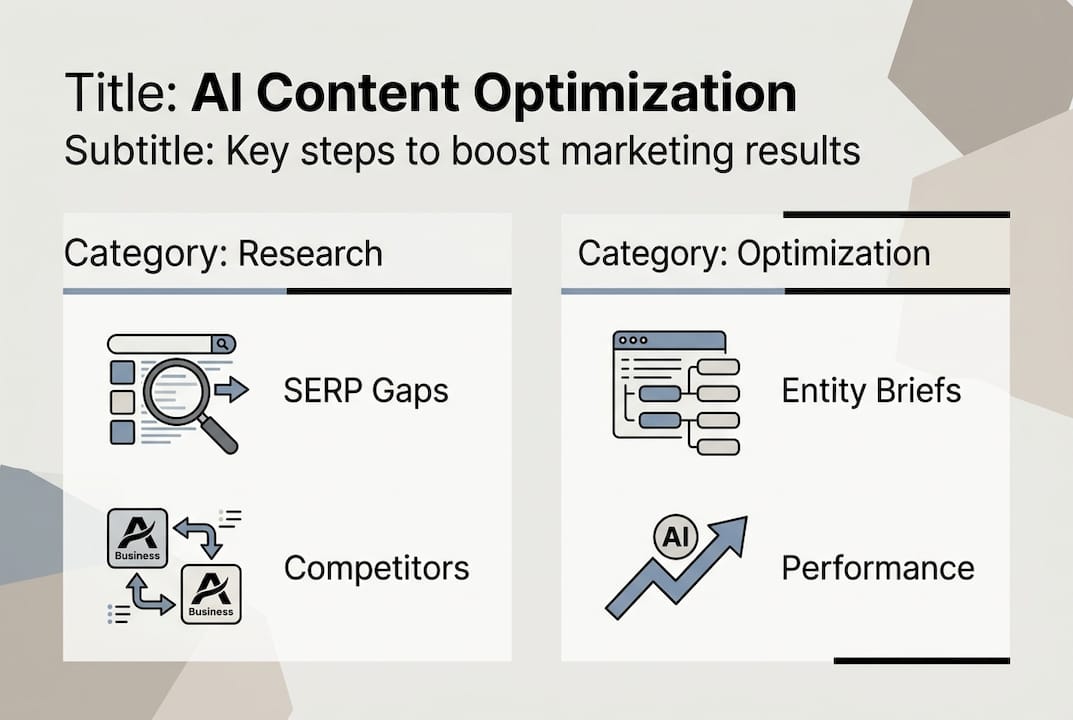
The optimization process begins with comprehensive competitor and SERP research. You analyze top-ranking content to identify keyword patterns, entity relationships, and content gaps that represent opportunities. Tools extract semantic entities, related topics, and question patterns that inform content structure. This research phase establishes the foundation for content that addresses user intent comprehensively rather than targeting isolated keywords.
Next, you create detailed content briefs with entity-based checklists. These briefs specify required entities, semantic relationships, content depth requirements, and structural elements like tables or lists. Entity checklists ensure AI-generated drafts cover topics comprehensively and establish topical authority. The brief acts as a blueprint that guides both AI drafting and human review, maintaining consistency across content production.
AI-assisted drafting accelerates initial content creation while human review ensures accuracy and brand alignment. You use AI models to generate first drafts based on briefs, then apply AI competitor analysis methods to benchmark output quality against top performers. Human editors refine voice, verify factual claims, and inject expertise that AI cannot replicate. This collaborative approach combines AI efficiency with human judgment.
Optimization extends beyond drafting to encompass structure, readability, and linking strategies. You implement these refinements:
- Break content into scannable sections with descriptive headings
- Optimize paragraph length for mobile readability
- Add internal links to related resources that support learning
- Include external citations for factual claims and statistics
- Implement structured data markup for rich results eligibility
Continuous performance tracking drives iterative improvements. Monitor metrics like impressions, click-through rates, time on page, and conversion actions to identify underperforming content. Update articles based on emerging search trends, algorithm changes, and user feedback. This ongoing refinement cycle keeps content relevant and maintains competitive positioning over time.
Core methodologies and best practices for AI content optimization
Core methodologies include 5-step loops where you research SERPs and competitors, create briefs with entity checklists, AI draft, optimize for structure and readability and links, then measure and iterate. This systematic approach prevents the common pitfall of treating AI as a one-time content generator rather than an integrated optimization tool.
The research phase requires thorough SERP and competitor analysis to understand what content currently satisfies user intent. You identify content gaps, outdated information, and emerging questions that represent opportunities. Keyword clustering reveals topic relationships that inform content architecture. Entity extraction from top-ranking pages shows which concepts and relationships algorithms associate with your target topics.
Briefing translates research insights into actionable specifications. Your brief should include target entities, required semantic relationships, content depth guidelines, and structural requirements. Specify tone, reading level, and brand voice parameters. Include example snippets that demonstrate desired style. Clear briefs reduce revision cycles and improve first-draft quality from AI tools.
Drafting with AI accelerates content production when guided by comprehensive briefs. You generate initial versions, then apply human expertise to refine accuracy, inject original insights, and strengthen argumentation. Entity optimization with AI ensures content covers topics comprehensively and establishes topical authority through semantic relationships.

Optimization for AI search emphasizes chunking, topical depth, citation-worthiness, structured data, Q&A formats, non-promotional tone, and E-E-A-T signals. Content chunking breaks information into discrete, quotable segments that AI systems can extract and cite. Topical depth demonstrates expertise through comprehensive coverage rather than surface-level summaries. Citation-worthy content includes specific data, expert insights, and original research that other creators reference.
Structured data markup helps search engines understand content relationships and eligibility for rich results. Implement FAQ schema, how-to schema, and article schema where appropriate. Q&A formats address specific user questions directly, increasing chances of featured snippet selection. Maintain a helpful, informative tone that prioritizes user value over promotional messaging.
E-E-A-T signals demonstrate experience, expertise, authoritativeness, and trustworthiness. Include author credentials, cite authoritative sources, update content regularly, and provide verifiable information. These quality indicators influence both traditional search rankings and AI citation selection.
Pro Tip: Create content templates that incorporate structural best practices like optimal heading hierarchy, entity placement patterns, and internal linking frameworks to streamline production while maintaining quality standards.
Measure success through multiple KPIs beyond rankings. Track organic impressions, click-through rates, time on page, conversion actions, and AI citation frequency. Compare performance across content types to identify what resonates with your audience. Use analytics insights to refine your optimization methodology continuously.
Balancing AI automation and human expertise for optimal results
Hybrid AI-human workflows outperform pure AI or human approaches by leveraging AI for drafts, research, and optimization while humans provide expertise, voice refinement, and edge case handling, achieving 4x traffic increases and higher conversions. This collaborative model recognizes that AI excels at pattern recognition and content generation speed, while humans contribute strategic thinking and nuanced judgment.
Pure AI content creation produces generic output that lacks distinctive voice and often misses nuanced context. AI models generate text based on training data patterns, which can result in factually accurate but unremarkable content. Without human refinement, AI content tends toward safe, middle-ground positions that fail to establish thought leadership or provide unique insights.
Human-only content creation delivers high quality but cannot match AI production speed or data analysis capabilities. Manual research and writing require significant time investment, limiting content volume. Writers may miss optimization opportunities that AI tools identify through comprehensive SERP analysis and entity mapping.
The hybrid model combines strengths while mitigating weaknesses. AI handles time-consuming research, generates initial drafts, and suggests optimization improvements. Humans apply domain expertise, refine messaging for brand alignment, and address complex scenarios requiring judgment. This division of labor maximizes both quality and efficiency.
| Approach | Benefits | Limitations | Best Use Cases |
|---|---|---|---|
| AI-only | Fast production, consistent formatting, data-driven optimization | Generic voice, factual errors, lacks expertise | High-volume informational content with human review |
| Human-only | Authentic voice, nuanced judgment, deep expertise | Slow production, limited scale, inconsistent optimization | Thought leadership, sensitive topics, brand storytelling |
| Hybrid | 4x traffic increases, 30%+ conversion lifts, scalable quality | Requires workflow design, tool integration, training | Most content marketing, SEO-focused articles, product content |
Empirical benchmarks show significant lifts in AI citation usage, structure quality, traffic, impressions, and conversion rates when using hybrid models. Organizations implementing structured hybrid workflows report 4x organic traffic increases compared to previous manual processes. Conversion rate improvements of 30% or more result from better-optimized content that addresses user intent comprehensively.
Humans remain essential for rare, complex, or safety-sensitive content where AI limitations pose risks. Medical advice, legal guidance, financial recommendations, and jurisdiction-specific instructions require expert verification. AI models trained on general datasets cannot reliably handle specialized scenarios or emerging situations absent from training data.
Pro Tip: Establish clear review protocols that specify which content types require expert verification versus light editing, optimizing resource allocation while maintaining quality standards across your content portfolio.
The AI content creation process benefits from defined roles where AI handles initial heavy lifting and humans focus on strategic refinement. This workflow prevents bottlenecks while ensuring output meets quality standards. Train team members on effective AI prompting and output evaluation to maximize hybrid model benefits.
Addressing AI limitations and ensuring content quality and compliance
AI struggles with rare scenarios, jurisdiction specifics, and safety-sensitive steps, requiring mitigation via clear headings, human SME input, and prompt clarifications. These limitations stem from AI training on general datasets that underrepresent edge cases and specialized knowledge domains. Content strategists must recognize when AI outputs require expert verification to prevent misinformation.
Rare scenarios present challenges because AI models lack sufficient training examples to generate reliable guidance. When creating how-to content for uncommon situations, AI may produce plausible-sounding but inaccurate instructions. For example, AI might suggest general troubleshooting steps for rare equipment malfunctions without understanding model-specific requirements. Human experts must verify and supplement AI-generated content for specialized topics.
Jurisdiction-specific matters require localized expertise that general AI models cannot provide reliably. Tax regulations, legal requirements, and compliance procedures vary significantly across regions. AI trained primarily on US data may generate incorrect guidance for Canadian or European contexts. Always involve subject matter experts familiar with relevant jurisdictions when creating location-specific content.
Safety-sensitive content demands rigorous human review to prevent potentially harmful misinformation. Medical procedures, electrical work, chemical handling, and similar topics require expert verification. AI may omit critical safety warnings or suggest dangerous shortcuts based on incomplete pattern matching. Implement mandatory expert review protocols for any content where errors could cause injury or significant harm.
Mitigate AI content risks through these practices:
- Include clear disclaimers identifying AI-generated sections and their limitations
- Label edge cases and rare scenarios requiring professional consultation
- Involve subject matter experts in reviewing technical and specialized content
- Implement custom prompt engineering and fine-tuning for domain-specific accuracy
- Establish quality checklists that flag high-risk content for enhanced review
Custom prompt engineering improves AI output quality by providing context, constraints, and examples specific to your content needs. Fine-tuning models on your existing high-quality content helps maintain brand voice and domain expertise. These investments reduce revision cycles and improve first-draft accuracy significantly.
Google penalizes scaled abuse, not AI itself, with success depending on originality, expertise, and user-first content that emphasizes E-E-A-T. Search engines focus on content quality and user value rather than creation method. AI-generated content ranks well when it demonstrates expertise, provides original insights, and satisfies user intent comprehensively.
Avoid generic or thin content that provides no value beyond keyword targeting. AI makes it easy to produce high volumes of low-quality content, but this approach risks penalties and wastes resources. Focus on creating comprehensive resources that answer user questions thoroughly and provide actionable insights. Every piece should offer unique value that justifies its existence.
Maintain originality through human-added insights, case studies, and proprietary data. AI-generated frameworks provide structure, but original examples and expert commentary differentiate your content from competitors. Include specific statistics, real-world applications, and lessons learned from implementation experience. These elements establish authority and encourage citations from other creators.
User-first focus means prioritizing helpful information over promotional messaging. Content should educate and inform rather than constantly pushing products or services. Human oversight in AI content ensures this balance by identifying where AI outputs drift toward generic promotional language. Edit ruthlessly to maintain informational value throughout.
Accelerate your content optimization with advanced AI tools
Effective content optimization requires more than basic AI writing assistants. You need comprehensive platforms that integrate research, drafting, optimization, and performance analysis into unified workflows. The challenge lies in accessing multiple AI models with different strengths while maintaining consistent quality and brand voice across all content.
Sofia🤖 provides access to over 60 state-of-the-art AI models including GPT-4o, Claude 4.0, and Gemini 2.5 through a single platform, enabling you to match specific content tasks with optimal model capabilities. Compare outputs across models to identify which performs best for research versus drafting versus optimization. Document analysis features help you extract insights from competitor content and industry reports efficiently. Team collaboration tools ensure consistent workflows as you scale content production. Enterprise security with GDPR compliance and encryption protects sensitive content strategies and proprietary data throughout the optimization process.
Frequently asked questions about AI content optimization
What are the key steps in AI content optimization?
The core workflow includes SERP research to identify content gaps and entity relationships, creating detailed briefs with optimization checklists, AI-assisted drafting with human refinement, structural optimization for readability and linking, and continuous performance monitoring with iterative updates. Each step builds on the previous to create content that satisfies both user intent and search algorithm requirements.
How do I balance AI tools with human review effectively?
Use AI for research, initial drafting, and data analysis while humans provide expertise, brand voice refinement, and judgment on complex scenarios. Establish clear review protocols that specify which content types require expert verification versus light editing. This division of labor maximizes efficiency while maintaining quality standards across your content portfolio.
What are common pitfalls to avoid when using AI for content?
Avoid treating AI as a one-time generator rather than an optimization tool requiring iterative refinement. Do not publish AI outputs without verifying factual accuracy and adding original insights. Prevent generic content by incorporating specific examples, proprietary data, and expert commentary. Never skip human review for specialized, jurisdiction-specific, or safety-sensitive topics where AI limitations pose significant risks.
How can I measure the success of AI-optimized content?
Track multiple metrics beyond rankings including organic impressions, click-through rates, time on page, conversion actions, and AI citation frequency. Compare performance across content types to identify what resonates with your audience. Monitor how often your content appears in AI-generated summaries and featured snippets. Use these insights to refine your AI content creation guide and optimization methodology continuously.
When should human expertise be prioritized over AI automation?
Prioritize human expertise for rare scenarios, jurisdiction-specific guidance, safety-sensitive instructions, thought leadership content, and brand storytelling. These situations require nuanced judgment, specialized knowledge, or authentic voice that AI cannot reliably replicate. Implement mandatory expert review for medical, legal, financial, or technical content where errors could cause harm or significant consequences.