
Many leaders believe AI automatically delivers productivity gains, yet over 60% of AI initiatives fail to meet expectations. The gap between promise and performance stems from strategic barriers like unclear leadership vision and unprepared data environments. Understanding what AI truly means for your business operations and how to navigate common adoption pitfalls is essential before investing time and resources. This guide provides practical insights to help you integrate AI effectively, enhance team collaboration, and achieve measurable efficiency improvements.
Table of Contents
- Key Takeaways
- Understanding AI for business: beyond the hype
- Common barriers to AI adoption and how to overcome them
- Engineering AI as a sustainable business capability
- Practical steps to integrate AI for productivity and collaboration
- Explore sofiabot.ai for smarter AI integration
- Frequently asked questions about AI for business
Key Takeaways
| Point | Details |
|---|---|
| Strategic leadership required | Clear executive vision and a roadmap align AI initiatives with business goals and secure ongoing support and funding. |
| Data readiness matters | Unprepared data, silos, and inconsistent formats derail AI initiatives and must be resolved before deploying pilots. |
| AI as a capability | AI should be treated as an ongoing capability with processes for continuous improvement rather than a one time project. |
| Organizational readiness necessary | Mature processes, documented workflows, and stable data practices enable AI to integrate and deliver measurable efficiency gains. |
Understanding AI for business: beyond the hype
AI is not a single technology you plug into your operations and watch productivity soar. It represents a suite of tools and methods that automate tasks, analyze patterns, and enhance decision-making across your organization. The confusion starts when businesses treat AI as a magic solution rather than a strategic capability requiring careful planning and integration.
Many organizations overestimate how easily AI fits into existing systems. Strategic barriers such as lack of strategy or leadership negatively impact adoption success and performance. Without executive vision defining what AI should accomplish and how it aligns with business goals, even the most advanced tools deliver disappointing results. You need a clear roadmap before selecting technologies or launching pilots.
Common barriers include unprepared data environments where information lives in silos, inconsistent formats prevent analysis, and quality issues undermine AI accuracy. Fragmented integration efforts compound these problems when different departments adopt incompatible tools without coordination. The result is wasted investment and frustrated teams who lose confidence in AI's potential.
Shifting your perspective from AI as a project to AI as a capability changes everything. Instead of viewing implementation as a one-time initiative with a defined end date, you build ongoing processes for continuous improvement and adaptation. This approach acknowledges that real-time AI benefits emerge through sustained effort rather than instant transformation.
Key misconceptions to avoid:
- AI requires minimal technical expertise to deploy effectively
- Any data will work without cleaning or standardization
- AI tools automatically integrate with existing software systems
- Results appear immediately after implementation
- One AI solution fits all business needs and departments
Understanding these realities helps you set realistic expectations and allocate appropriate resources. The businesses that succeed with AI recognize it demands strategic planning, technical preparation, and organizational change management. You cannot skip these foundational steps and expect positive outcomes.
Common barriers to AI adoption and how to overcome them
Research surveying 193 AI specialists reveals that strategic issues such as lack of leadership and company maturity inhibit adoption more than technical challenges alone. Strategic leadership sets the vision and roadmap necessary for AI success by defining clear objectives, securing budget, and championing organizational buy-in. Without this executive commitment, AI initiatives stall regardless of technical merit.
Company maturity significantly impacts adoption effectiveness. Mature organizations with established processes, documented workflows, and stable data practices integrate AI more successfully than younger companies still defining their operations. If your business lacks process documentation or consistent data management, you must address these gaps before expecting AI to deliver value.
Data unreadiness represents a critical barrier that derails many implementations. AI algorithms require clean, accessible, and integrated data to function properly. When information lives in disconnected systems, contains errors, or uses inconsistent formats, AI tools cannot generate reliable insights. You must invest in data preparation as a prerequisite, not an afterthought.
Integration failures stem from underestimating technical and organizational complexities. Connecting AI tools to existing software, training employees on new workflows, and managing change across departments demands more effort than most leaders anticipate. These challenges explain why enthusiasm at launch often fades into frustration during implementation.
"The gap between AI promise and performance reflects inadequate preparation more than technological limitations. Strategic planning and data readiness determine success."
Practical solutions to overcome these barriers:
- Establish executive sponsorship with clear accountability for AI strategy and outcomes
- Document existing processes before introducing AI to identify optimization opportunities
- Audit data quality and accessibility, then invest in cleaning and integration
- Start with focused pilots in specific departments rather than enterprise-wide rollouts
- Build cross-functional teams combining technical expertise with business knowledge
- Create feedback loops to continuously refine AI applications based on real usage
Building AI capabilities incrementally allows you to learn from early implementations and adjust your approach. This phased strategy reduces risk while building organizational confidence. Teams see tangible results from initial projects, which generates momentum for broader adoption.
Fostering collaboration between IT, operations, and business units prevents the siloed implementations that undermine integration. When these groups work together from the start, you avoid incompatible tools and ensure AI solutions address actual business needs. Regular communication keeps everyone aligned on goals and progress.
Investing in employee training and change management increases adoption rates. Even the best AI tools fail if your team does not understand how to use them or resists changing established workflows. Provide hands-on training, celebrate early wins, and address concerns transparently to build enthusiasm.
The AI content creation guide demonstrates how structured processes enable successful AI application. Similarly, understanding real-time AI advantages helps you prioritize use cases that deliver immediate value while building toward longer-term transformation.
Engineering AI as a sustainable business capability
Successful organizations approach AI differently than those who struggle. Industrial AI adopters engineer AI as an ongoing capability, not one-off projects, using process archaeology and custom benchmarks. This shift from project thinking to capability building creates lasting impact that compounds over time rather than delivering isolated improvements that fade.
Process archaeology involves analyzing and optimizing existing workflows before deploying AI. You map how work actually flows through your organization, identify bottlenecks and inefficiencies, and determine where AI can create the most value. This upfront analysis prevents wasting resources on automating broken processes or solving the wrong problems.

Custom evaluations tailored to your specific business needs outperform generic benchmarks in measuring AI success. Standard metrics like accuracy or processing speed matter less than whether AI helps you achieve strategic objectives. Define success criteria based on business outcomes such as reduced cycle times, improved decision quality, or enhanced customer satisfaction.
Comparing traditional project approaches to AI-as-capability reveals fundamental differences:
| Dimension | Project Approach | Capability Approach |
|---|---|---|
| Timeframe | Fixed end date | Continuous improvement |
| Scope | Isolated use case | Integrated across processes |
| Ownership | Single department | Cross-functional teams |
| Success metrics | Technical performance | Business outcomes |
| Investment pattern | Upfront budget | Sustained resource allocation |
| Learning model | Post-project review | Real-time adaptation |
Building AI as a capability requires different resource allocation and organizational structures. Instead of funding discrete projects, you establish ongoing budgets for AI development and maintenance. Rather than temporary project teams, you create permanent groups responsible for AI strategy, implementation, and optimization.
This approach acknowledges that AI effectiveness improves through continuous refinement. Initial deployments provide baseline performance, then iterative enhancements driven by usage data and feedback increase value over time. You build institutional knowledge about what works in your specific context rather than relying on vendor promises or generic best practices.
Integrating AI holistically across processes amplifies impact beyond what isolated implementations achieve. When multiple systems share data and coordinate actions, you unlock synergies impossible with standalone tools. Customer service AI that accesses inventory data, for example, resolves issues faster than one limited to conversation alone.
The image analysis AI guide illustrates how specialized AI capabilities integrate into broader workflows. Similarly, voice recognition AI models demonstrate how natural interfaces enhance accessibility and adoption across diverse user groups.
Pro Tip: Prioritize building AI foundations aligned with your strategic goals before pursuing trendy applications. Strong data infrastructure, clear governance, and cross-functional collaboration create more value than rushing to implement the latest AI features without proper groundwork.
Practical steps to integrate AI for productivity and collaboration
Starting AI adoption successfully requires a structured approach focused on enhancing team collaboration and operational efficiency. Process archaeology and custom evaluation are critical steps before deploying AI tools to ensure alignment and impact. These practices help you avoid common pitfalls and maximize return on investment.
Five practical steps to begin AI integration:
- Assess current processes by mapping workflows that impact productivity and identifying improvement opportunities
- Prepare data infrastructure through auditing quality, integrating disparate sources, and establishing governance policies
- Choose AI tools aligned with specific business needs rather than selecting based on popularity or vendor hype
- Pilot projects in focused areas with clear success metrics and stakeholder buy-in before scaling
- Evaluate and scale by analyzing pilot results, refining approaches, and expanding successful implementations
Identifying and mapping existing workflows reveals where AI creates the most value. You document how teams currently complete tasks, measure performance, and pinpoint friction points. This analysis ensures you automate processes worth improving rather than simply digitizing inefficiency.
Investing in data integration and preparation enables AI effectiveness. Clean, accessible data in consistent formats allows algorithms to generate accurate insights and recommendations. Without this foundation, even sophisticated AI tools produce unreliable results that undermine trust and adoption.
Selecting AI tools requires matching capabilities to your specific needs. Generic solutions often miss the mark, while specialized tools designed for your industry or use case deliver better outcomes. Consider factors like integration complexity, training requirements, and vendor support when evaluating options.
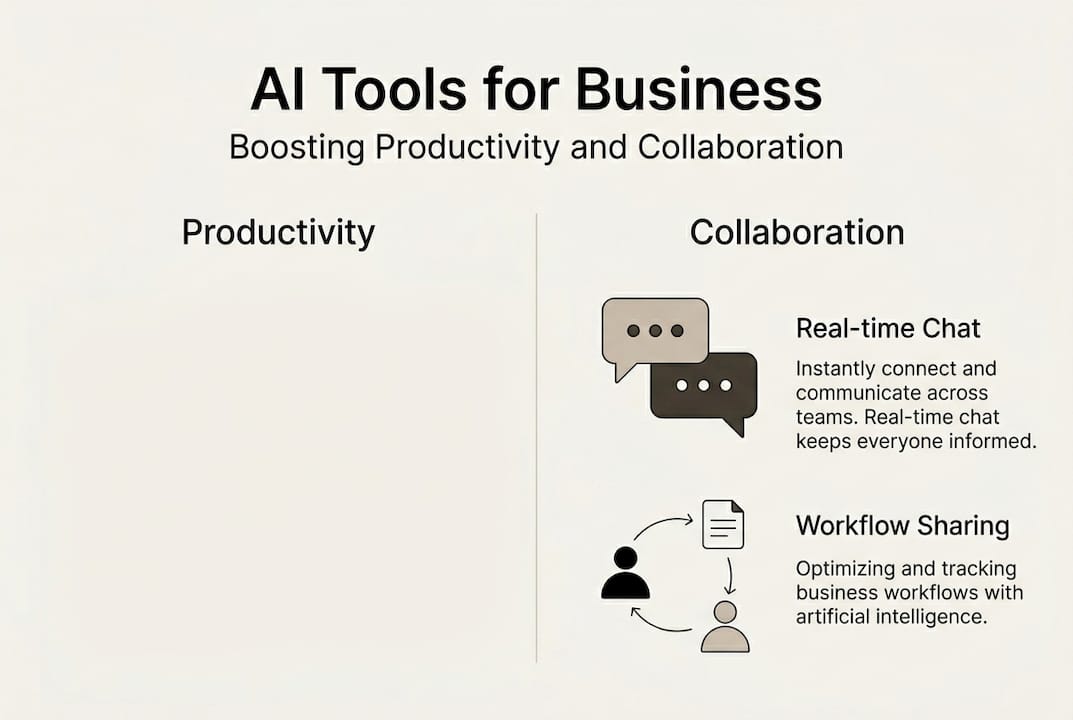
Key AI tool types and their benefits:
| Tool Type | Productivity Benefit | Collaboration Benefit |
|---|---|---|
| Personal assistants | Automate scheduling and routine tasks | Coordinate team calendars and meetings |
| Document analysis | Extract insights from reports faster | Share findings across departments |
| Real-time analytics | Identify issues as they emerge | Enable data-driven team decisions |
| Communication tools | Transcribe and summarize discussions | Improve remote team alignment |
| Project management | Predict delays and resource needs | Visualize dependencies and progress |
Using a phased approach with continuous monitoring allows you to adjust based on real-world performance. Start small, learn from initial deployments, and expand gradually. This reduces risk while building organizational capability and confidence in AI applications.
Custom success metrics tied to business outcomes matter more than technical benchmarks. Define what improvement looks like for your organization, whether that means faster response times, higher quality outputs, or increased employee satisfaction. Measure against these criteria rather than generic AI performance standards.
Engaging cross-functional teams early ensures adoption and alignment. When IT, operations, and business units collaborate from the beginning, you avoid siloed implementations and ensure AI solutions address real needs. Regular communication keeps everyone informed and invested in success.
The AI-powered personal assistant demonstrates how targeted AI applications enhance daily productivity. Understanding real-time AI business applications helps you identify high-impact use cases for your specific context and priorities.
Pro Tip: Start with AI applications that augment human decision-making rather than attempting full automation. Tools that provide recommendations while keeping humans in the loop generate faster adoption and better outcomes than black-box systems that replace judgment entirely.
Explore sofiabot.ai for smarter AI integration
You have learned the strategic foundations and practical steps for successful AI adoption. Now you need tools designed to enhance business workflows and team collaboration without the complexity that derails many implementations. Sofiabot.ai offers an AI-powered personal assistant that streamlines operations by automating routine tasks, integrating data sources, and supporting better decision-making across your organization.
The platform provides access to over 60 state-of-the-art AI models, letting you choose the right tool for each specific task rather than forcing one-size-fits-all solutions. Real-time streaming responses, document analysis capabilities, and team collaboration features align with the strategic principles discussed throughout this guide. You can start with focused applications and expand as you build confidence and capability.
Using Sofiabot.ai accelerates meeting the strategic goals outlined in this guide by providing enterprise-grade security, flexible deployment options, and continuous improvements. The platform embodies the AI-as-capability approach rather than one-off project thinking, supporting your journey toward sustained productivity and collaboration gains.
Frequently asked questions about AI for business
What is the difference between AI as a capability and one-off projects?
AI as a capability involves continuous improvement and integration across business processes, while one-off projects have fixed scopes and end dates. The capability approach builds institutional knowledge and compounds value over time through iterative refinement. Projects deliver isolated improvements that often fade without sustained attention and resources.
How do I prepare data for AI adoption?
Start by auditing data quality, accessibility, and consistency across your systems. Clean errors, standardize formats, and integrate disparate sources into unified repositories that AI tools can access. Establish governance policies defining data ownership, security, and usage rights. This preparation phase typically requires significant investment but determines whether AI implementations succeed or fail.
What leadership roles are essential for successful AI initiatives?
Executive sponsorship provides vision, secures resources, and champions organizational change necessary for AI success. Cross-functional team leaders coordinate between IT, operations, and business units to ensure alignment. Data stewards maintain quality and governance. Change management specialists help employees adapt to new workflows and tools. All these roles working together create the conditions for sustained AI impact.
How do I select AI tools that fit my business needs?
Define specific problems you want to solve and outcomes you want to achieve before evaluating tools. Prioritize solutions designed for your industry or use case rather than generic platforms. Assess integration complexity with existing systems, training requirements for your team, and vendor support quality. Consider starting with platforms like the AI personal assistant that offer flexibility and multiple models rather than single-purpose tools. Pilot candidates in controlled environments before committing to enterprise-wide deployments.
Why do many AI projects fail despite promising technology?
Most failures stem from strategic and organizational issues rather than technical limitations. Lack of clear leadership vision, unprepared data environments, inadequate change management, and unrealistic expectations cause projects to underdeliver. Organizations that skip process analysis and rush to implementation waste resources automating broken workflows. Understanding real-time AI benefits requires recognizing that technology alone cannot overcome poor planning and execution. Success demands strategic preparation, sustained investment, and continuous refinement based on real-world performance.