
87% of marketers now use AI for content creation, and those who do publish 42% more content every month. Yet most teams still argue about whether AI replaces writers, hurts SEO, or just produces generic fluff. The reality is more nuanced and more useful than either camp admits. This guide breaks down exactly what AI does in a modern content workflow, where it wins, where it stumbles, and how you can use it to produce better content faster without sacrificing the quality your audience expects.
Table of Contents
- What is AI in content creation?
- How does AI fit in the content creation workflow?
- AI vs human vs hybrid: Comparing outcomes
- Strengths and pitfalls of AI for content creators
- Maximizing results: Practical tips for hybrid AI/human content
- Level up your content with smart AI assistants
- Frequently asked questions
Key Takeaways
| Point | Details |
|---|---|
| Hybrid is best | Combining AI efficiency with human creativity yields the highest content quality and results. |
| AI speeds production | AI tools can help you create content up to 42% faster than manual efforts alone. |
| Edit for quality | Human review and personalization ensure AI-generated content meets strategic and brand goals. |
| Cost-effective scaling | AI-driven content costs up to 4.7 times less than fully human-written equivalents. |
| SEO still values expertise | Google rewards well-edited, expert content, regardless of its AI or human origin. |
What is AI in content creation?
At its core, AI content creation relies on Large Language Models (LLMs). These are neural networks trained on massive text datasets that learn to predict and generate human-like language. Think of an LLM as a very well-read collaborator who has absorbed billions of documents and can draft, summarize, or reframe ideas on demand.
But modern AI tools go further than basic text generation. Techniques like Retrieval Augmented Generation (RAG) pull in real-time data from external sources before generating a response, which dramatically reduces the hallucinations (made-up facts) that plagued earlier models. As AI content creation has evolved, agentic workflows now chain multiple tasks together automatically, so an AI can research a topic, outline an article, draft sections, and flag SEO gaps in a single run.
This evolution matters because it shifts AI from a simple text generator into a genuine workflow assistant. You can learn more about how these systems compare by exploring AI models explained.
"AI is not replacing the content strategist. It is giving the strategist a faster, more scalable set of hands."
Understanding this distinction changes how you deploy AI. It is not a replacement for strategic thinking. It is an amplifier for the work you are already doing.
How does AI fit in the content creation workflow?
The most effective teams use AI at specific stages rather than handing over the entire process. A typical hybrid workflow looks like this: the human defines strategy and goals, AI assists with ideation, research, outlining, drafting, and SEO suggestions, and the human returns for voice adjustments, fact-checking, and final review.

Here is how that plays out across the production pipeline:
| Stage | AI role | Human role |
|---|---|---|
| Strategy | Suggests topics, gaps, angles | Sets goals, audience, brand voice |
| Research | Summarizes sources, pulls data | Validates accuracy, adds context |
| Outlining | Generates structure options | Chooses best fit, adjusts flow |
| Drafting | Produces first draft quickly | Edits for tone, adds examples |
| SEO | Recommends keywords, meta tags | Reviews intent alignment |
| Review | Flags readability issues | Final approval and publishing |
The numbered steps below show a practical sequence you can follow today:
- Define your goal. Know the audience, intent, and desired action before you write a single prompt.
- Brief the AI clearly. Provide context, tone, word count, and any must-include facts.
- Generate a draft. Let AI produce the first version without overthinking it.
- Edit for voice and accuracy. Add your perspective, real examples, and verify every claim.
- Optimize for SEO. Use AI to check keyword density, headers, and meta descriptions.
- Publish and measure. Track performance and feed insights back into your next brief.
For a deeper walkthrough, the step-by-step AI content guide covers each phase in detail. You can also explore AI productivity best practices to build habits that stick.
Pro Tip: Treat your AI brief like a job posting. The more specific you are about tone, audience, and purpose, the less editing you will do on the back end.
AI vs human vs hybrid: Comparing outcomes
Hard numbers settle a lot of debates. AI-generated content costs roughly $131 per blog post compared to $611 for human-written content. That is a significant budget difference. But cost alone does not tell the full story.
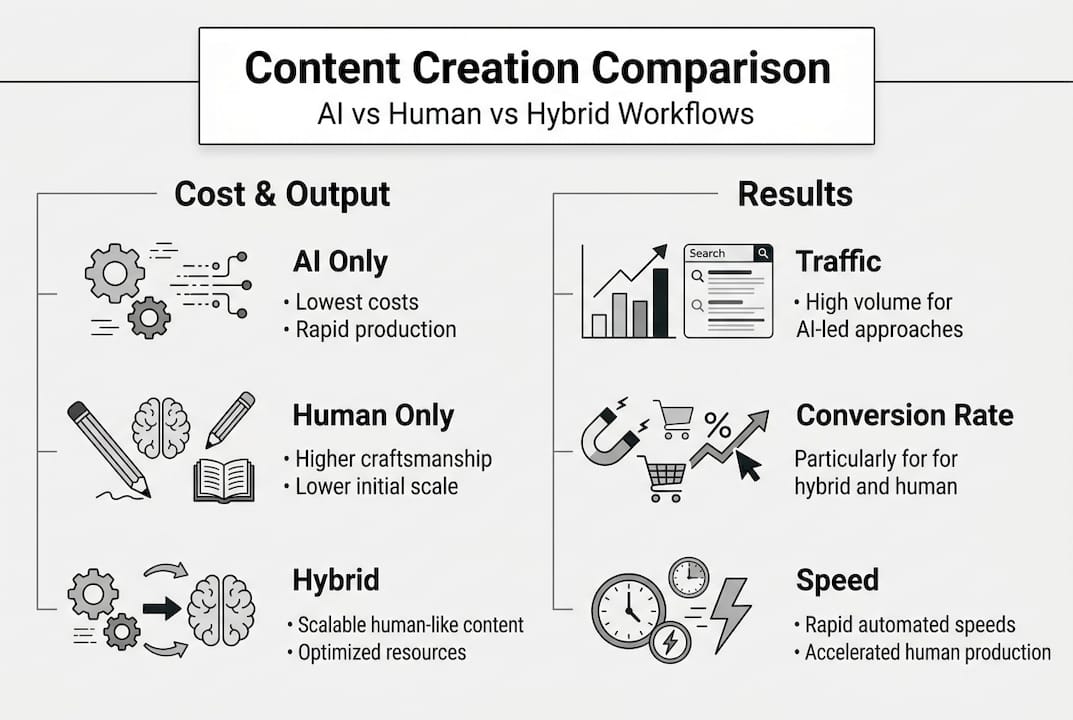
| Method | Cost per post | Monthly output | Avg. traffic | Conversion rate |
|---|---|---|---|---|
| AI only | ~$131 | High | Moderate | ~2.1% |
| Human only | ~$611 | Low | High | ~5.2% |
| Hybrid | ~$220 | High | Highest | ~4.7% |
The hybrid approach wins on almost every metric that matters for sustainable growth. It delivers higher traffic and conversions while keeping costs well below pure human production.
SEO performance adds another layer. Pure AI content can show short-term ranking gains but tends to drop over time as search engines reward depth and authority. AI-assisted content on an established site, by contrast, regularly ranks in the top 10 because it combines scale with genuine expertise.
Key insight: The hybrid model is not a compromise. It is the most strategically sound approach for teams that want both volume and quality.
For teams managing large document sets or research-heavy content, AI document analysis can dramatically cut the time spent synthesizing sources before you even start writing.
Pro Tip: Run a small test. Produce three articles using each method and compare traffic, time on page, and conversions after 60 days. The data will make the case for hybrid better than any opinion.
Strengths and pitfalls of AI for content creators
AI is genuinely impressive at structured, repeatable, and data-driven tasks. A Harvard Business School analysis found that AI improves task completion by 12.2% and speeds up execution by 25.1% across a range of knowledge work. Those are real gains.
But the same research identified what researchers call the "jagged frontier": AI performs brilliantly on some tasks and surprisingly poorly on others, often in ways that are hard to predict. Deep storytelling, nuanced cultural references, and genuinely original arguments still trip up even the best models.
Here is where AI reliably adds value:
- Bulk drafting of product descriptions, social captions, and email sequences
- Summarizing long research papers, reports, or transcripts
- SEO structuring including headers, meta descriptions, and internal link suggestions
- Repurposing existing content into new formats (blog to newsletter, video script to article)
- Ideation when you need 20 headline options in 30 seconds
And here is where you need to stay alert:
- AI can hallucinate sources, statistics, and quotes. Always verify.
- Without editing, AI drafts often sound generic and flat, lacking a distinct voice.
- Unedited AI content risks SEO penalties and fails Google's E-E-A-T framework (Expertise, Experience, Authoritativeness, Trustworthiness).
- AI struggles with emotional resonance, humor, and the kind of personal story that builds audience loyalty.
"Google rewards E-E-A-T regardless of the tool used to create content. The question is never AI or human. It is always: does this serve the reader?"
The AI text analysis guide offers a useful framework for evaluating AI output quality before it goes live.
Maximizing results: Practical tips for hybrid AI/human content
Getting real ROI from AI content is not about using more AI. It is about using it smarter. A Forrester study on Jasper found a 342% return on investment driven by time savings and avoided agency costs. That kind of result does not happen by accident.
Here are the practices that separate high-performing hybrid teams from everyone else:
- Start with a sharp brief. Define the goal, audience, tone, and key message before you open any AI tool. Vague inputs produce vague outputs.
- Use sequential prompts for complex content. Agentic AI workflows work best when you break tasks into steps: research first, then outline, then draft, then optimize.
- Add personal anecdotes and opinions. This is the single fastest way to make AI content feel human. One real example beats three generic paragraphs.
- Vary your structure. AI defaults to predictable formats. Break the pattern with a table, a short list, a bold question, or a one-sentence paragraph.
- Edit for voice last. Do your fact-checking and structural edits first, then read the whole piece aloud and adjust rhythm and tone.
- Measure and iterate. Track which AI-assisted articles perform best and reverse-engineer the prompts and editing decisions that made them work.
Pro Tip: Keep a "prompt library" of your best-performing briefs. Reusing and refining them over time is one of the highest-leverage habits a content team can build.
"Prompt engineering is not a technical skill. It is a communication skill. The better you explain what you want, the better the AI delivers."
For teams ready to scale, AI-powered content optimization and AI for business productivity are two resources worth bookmarking as you build out your workflow.
Level up your content with smart AI assistants
You now have a clear picture of how AI fits into content creation, where it adds the most value, and how to avoid the common traps. The next step is putting it into practice with tools that actually match your workflow.
Sofia🤖 gives content creators and marketing teams access to over 60 leading AI models, including GPT-4o, Claude 4.0, and Gemini 2.5, all in one platform. You can analyze documents, generate drafts, optimize for SEO, and collaborate with your team without switching between a dozen tools. Whether you are a solo creator scaling your output or a marketing team managing high-volume production, Sofia🤖 is built to support the hybrid workflows this guide recommends. Start with a plan that fits your team and see the difference structured AI assistance makes.
Frequently asked questions
Does Google penalize AI-generated content for SEO?
Google ranks content based on expertise, experience, authority, and trust, regardless of whether it is AI- or human-written. High-quality, well-edited content performs well either way.
What is prompt engineering in AI content creation?
Prompt engineering is the practice of writing specific, structured instructions for an AI to produce accurate, on-brand responses. Agentic AI workflows in particular rely on sequential, well-crafted prompts to chain tasks effectively.
How much faster is content created with AI?
AI tools make relevant tasks 25.1% faster and help users publish 42% more content per month on average.
Is hybrid AI/human content really better than AI-only?
Yes. Hybrid workflows consistently deliver higher traffic and conversion rates while keeping production costs well below human-only methods.
What are agentic workflows in AI content creation?
Agentic workflows use AI to chain multiple tasks together automatically, adapting each step based on the output of the previous one to handle complex, multi-stage content processes.