TL;DR:
- AI content performs worse on Google rankings and backlinks compared to human-written content.
- Combining AI with human input offers comparable quality and authority for better SEO results.
- Strategic human oversight, original data, and structured prompts are essential for high-performance AI content.
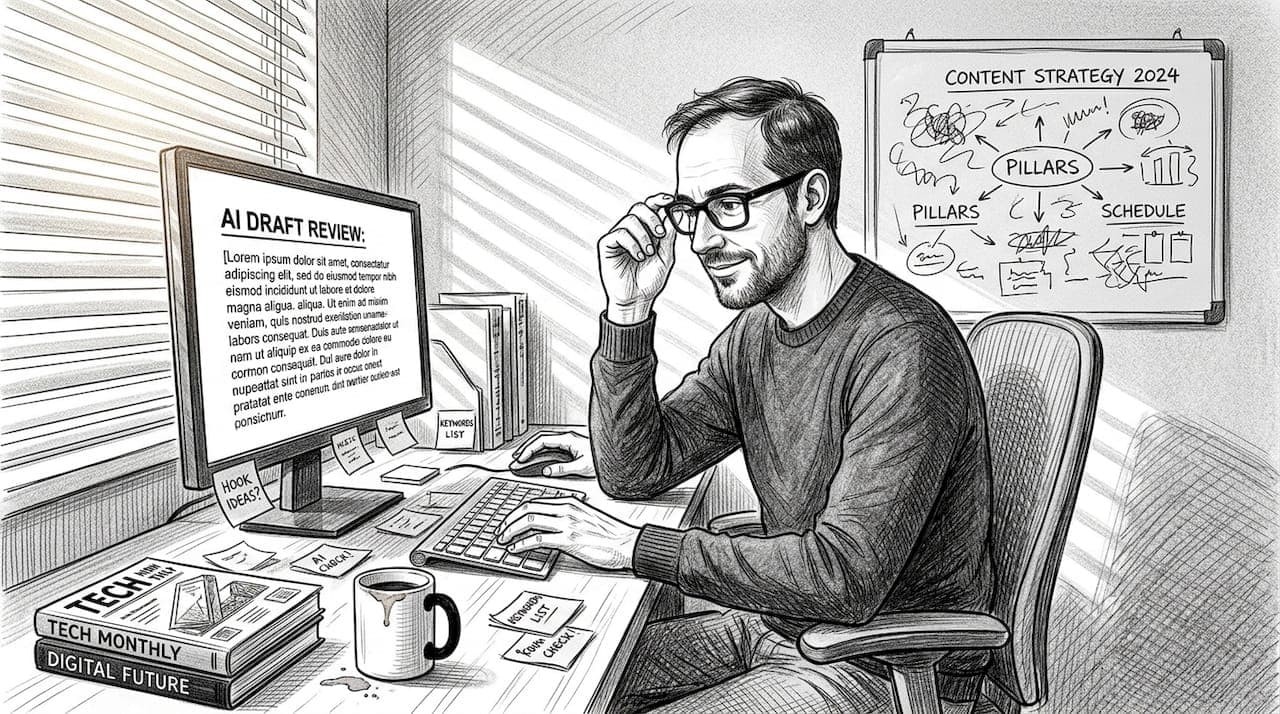
Most marketers assume that more AI equals better content. The reality is more nuanced. Pure AI content ranks 23% lower than human-written content on Google over a 16-month study tracking 4,200 articles. That single finding should reframe how you think about AI content generation entirely. This article walks you from the foundational mechanics of how AI creates content, through a clear comparison of the three main content strategies, into tactical frameworks for building high-performance AI-assisted content, and finally into how to measure what actually matters. If you've been treating AI as a replacement rather than a collaborator, this is the reset you need.
Table of Contents
- What is AI content generation and how does it work?
- Pure AI vs. AI-assisted vs. human content: Key differences and outcomes
- Building high-performance AI content: Strategies, prompts, and frameworks
- Measuring success: ROI, engagement, and traffic from AI content
- The uncomfortable truth: Why human insight still makes or breaks AI content
- Ready to implement smarter AI content generation?
- Frequently asked questions
Key Takeaways
| Point | Details |
|---|---|
| Human plus AI wins | Blending AI with expert human input is the current best practice for high-ranking, engaging content. |
| Huge time and ROI gains | Teams using AI tools can see over 4x ROI and save dozens of hours monthly with the right approach. |
| Strategic optimization is key | Effective frameworks, prompts, and dual SEO/AI strategies make or break success in AI-driven content. |
| Track impact metrics | Measuring engagement, traffic, and revenue is critical to iterate and maximize your AI content investment. |
What is AI content generation and how does it work?
AI content generation is the process of using machine learning models to produce written, visual, or structured content based on input instructions called prompts. These systems are built on large language models (LLMs), which are trained on massive datasets of text from across the internet, books, and databases. The model learns patterns in language, context, and structure, then predicts what words should follow based on your prompt.
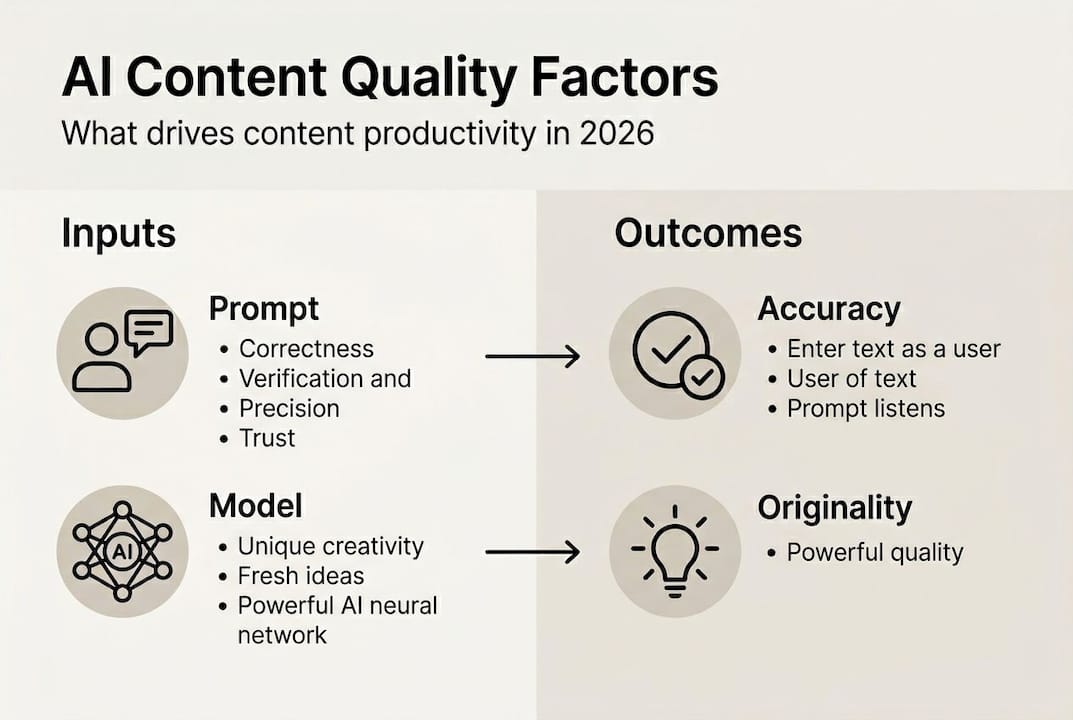
Understanding AI in content creation means recognizing that the output quality is directly tied to three variables: the quality of the training data, the design of your prompt, and the model's architecture. A vague prompt produces generic content. A structured prompt with context, audience details, and a clear goal produces something far more useful.
Common output formats include blog posts, email sequences, ad copy, social media captions, product descriptions, and long-form reports. The range of types of AI models available today means you can match the right model to the right task, whether that's a creative campaign brief or a technical white paper.
The business case for AI content generation is hard to ignore. Marketing teams that adopt AI content creation tools achieve 4.1x ROI, saving 12 hours per week, increasing output by 3.4x, and lifting engagement by 22%. Overall generative AI marketing ROI sits at 3.2x, with teams reaching positive returns in just 4.2 months.
Here's a quick look at how those efficiency gains break down:
| Metric | Without AI | With AI content tools |
|---|---|---|
| Weekly content hours | ~20 hrs | ~8 hrs |
| Monthly article output | 4 to 6 | 14 to 20 |
| Average engagement lift | Baseline | +22% |
| Time to positive ROI | Varies | ~4.2 months |
Key formats where AI delivers the strongest results:
- Blog posts and long-form articles (especially with human editing)
- Email subject lines and sequences
- Social media captions and ad copy
- Product descriptions at scale
- Content briefs and outlines for editorial teams
The efficiency gains are real. But efficiency without quality is just faster mediocrity. That's why the how matters as much as the what.
Pure AI vs. AI-assisted vs. human content: Key differences and outcomes
With an understanding of how AI content is created, we can now explore how different strategies actually measure up. There are three main approaches content teams use today, and they are not equally effective.
Pure AI content means publishing model output with minimal or no human editing. It's fast and cheap, but the performance data is sobering. Pure AI content earns 61% fewer backlinks than human-written content and ranks 23% lower on Google over time. The core problem is E-E-A-T: Google's framework for evaluating Experience, Expertise, Authoritativeness, and Trustworthiness. Pure AI content simply cannot demonstrate lived experience or original perspective.

AI-assisted content pairs AI-generated drafts with meaningful human input: rewrites, original data, expert quotes, and editorial judgment. When that human layer represents at least 30% of the final content, performance matches human-written content within 4%. That's a remarkable result and the strongest argument for a hybrid workflow.
Human-only content still sets the quality ceiling, particularly for thought leadership, investigative pieces, and content requiring deep subject matter expertise. But it's expensive and slow to scale.
| Content type | SEO ranking | Backlinks | Scalability | Cost |
|---|---|---|---|---|
| Pure AI | Lower (23% gap) | 61% fewer | Very high | Very low |
| AI-assisted | Near human | Competitive | High | Moderate |
| Human-only | Highest | Strongest | Low | High |
"Pure AI scales poorly long-term due to backlink and E-E-A-T gaps; assisted content wins via original data and authority signals."
Choosing the right workflow depends on your goals:
- Use pure AI only for low-stakes, high-volume tasks like product descriptions or internal summaries.
- Default to AI-assisted for any content meant to rank, convert, or build authority.
- Reserve human-only for flagship content: case studies, executive thought leadership, and original research.
Pro Tip: Before publishing any AI-assisted content, ask yourself: does this piece contain at least one data point, perspective, or example that couldn't have come from a generic training dataset? If not, it needs more human input.
For a deeper look at optimizing content with AI, the gap between good and great often comes down to how much original thinking you layer on top of the AI draft.
Building high-performance AI content: Strategies, prompts, and frameworks
After unpacking the outcome differences between methods, it's time to get tactical on how to implement winning AI content strategies. The difference between average AI content and high-performance AI content is almost always process, not the model itself.
Start with structured prompt design. A strong prompt includes the target audience, the goal of the content, the tone, a word count range, and at least one specific angle or hook. Vague prompts produce vague content. Think of your prompt as a creative brief: the more context you provide, the less editing you'll need on the back end.
Multi-agent strategies are gaining traction among advanced content teams. Instead of relying on one model to do everything, you use different models for different tasks. One model generates the outline, another drafts the body, a third checks for factual consistency, and a human editor finalizes tone and authority. This ensemble approach mirrors how a real editorial team works.
For AI content workflows that actually perform, the smartest teams are also optimizing for GEO (Generative Engine Optimization) alongside traditional SEO. As AI-powered search overviews become standard, content needs to be structured for dual discovery: appearing in both traditional search results and AI-generated answer panels. Structured prompts and GEO/SEO dual-optimization are now table stakes for content that wants to be found in 2026.
Here's a practical framework for building high-performance AI content:
- Brief the AI like a junior writer: give context, audience, goal, and constraints
- Layer in original data: proprietary stats, internal case studies, or expert quotes
- Run an E-E-A-T audit: does the content demonstrate real experience and authority?
- Optimize structure for AI overviews: use clear headers, concise definitions, and direct answers
- Human review is non-negotiable: check for factual accuracy, brand voice, and original perspective
Pro Tip: Build a prompt library for your most common content types. A tested prompt for a product comparison article will consistently outperform a freshly written one. Treat prompts like templates: refine them over time based on output quality.
Following best AI productivity practices means treating AI as a force multiplier for your existing editorial process, not a shortcut around it.
Measuring success: ROI, engagement, and traffic from AI content
With solid strategies in hand, the next imperative is tracking performance and learning from real-world evidence. AI content without measurement is just publishing on hope.
The essential KPIs for AI-driven content programs include organic traffic growth, engagement rate (time on page, scroll depth, shares), conversion rate, backlink acquisition, and content output volume. Tracking these alongside cost per piece gives you a true picture of ROI, not just a vanity metric.
Set benchmarks before you launch. If your baseline is 5 articles per month with a 2-minute average read time, you need a target for both output and quality after introducing AI. Without that baseline, you can't prove the impact.
The case studies are genuinely striking. AI-assisted content strategies have driven 945% organic traffic growth, 144% total traffic increases, a $50,000 sales pipeline generated in 90 days, and 405% growth in AI search traffic. These aren't outliers from enterprise teams. They're achievable by focused small and mid-sized teams with the right process.
| KPI | Baseline (no AI) | AI-assisted result |
|---|---|---|
| Organic traffic growth | Baseline | Up to 945% |
| Content output | 4 to 6 pieces/month | 14 to 20 pieces/month |
| Engagement rate | Baseline | +22% average |
| Sales pipeline (90 days) | Variable | $50k+ documented |
"ROI is highest in high-volume tasks; train teams, start with content and email; measure beyond time savings to engagement and traffic."
Common pitfalls to avoid:
- Measuring only time saved, not content quality or traffic outcomes
- Publishing AI content without tracking it separately from human-written pieces
- Ignoring backlink data, which is one of the clearest signals of authority and long-term ranking potential
- Failing to iterate: your first AI workflow won't be your best one
For a step-by-step approach, the AI content creation guide walks through how to build measurable content programs from the ground up.
The uncomfortable truth: Why human insight still makes or breaks AI content
Beyond metrics and methodologies, let's confront the reality of what truly drives AI content success in practice. We've seen the data. We know AI-assisted content can nearly match human-written performance. But here's what often gets glossed over: the "human" part of AI-assisted is doing most of the heavy lifting.
The 4% performance gap between AI-assisted and human-written content exists only when human rewrites, original data, and expert attribution are genuinely present. Strip those out and you're back to pure AI territory, with all its ranking and backlink penalties.
The risk of overreliance on automation is real. Teams that use AI to scale volume without scaling editorial judgment end up with a lot of content that earns very little. Search engines and readers in 2026 are both sophisticated enough to recognize when a piece has nothing original to say.
What actually moves the needle is strategic human input: a counterintuitive angle, a proprietary data point, a named expert's perspective. These are the signals that earn backlinks, build authority, and create the kind of content people actually share. For a broader view of how AI fits into business strategy, the AI for business guide covers the organizational mindset shift required to make this work at scale.
Ready to implement smarter AI content generation?
You now have the framework: understand the mechanics, choose the right content strategy, build with structured prompts and human oversight, and measure what actually matters. The next step is putting it into practice with tools that can keep up.
The Sofiabot AI platform gives content teams access to over 60 state-of-the-art AI models, including GPT-4o, Claude 4.0, and Gemini 2.5, all in one place. Whether you're building content workflows, analyzing documents, or collaborating across teams, Sofia brings the right model to every task. For a deep dive on AI content strategy and execution, the blog is your starting point. Start experimenting, measure your results, and build the hybrid workflow that actually performs.
Frequently asked questions
Is AI-generated content good for SEO in 2026?
AI-assisted content with meaningful human editing and expert input can match human-written SEO performance within 4%, but pure AI lags significantly with lower rankings and 61% fewer backlinks over time.
How much time and ROI can AI save for content marketers?
Teams report saving 12 hours per week and achieving 4.1x ROI from AI content creation, with positive returns typically reached within 4.2 months of adoption.
What makes AI-assisted content outperform pure AI in rankings?
Human rewrites, original data, and expert attribution address the E-E-A-T and authority gaps that pure AI content cannot fill, resulting in stronger backlink profiles and higher search rankings.
Can small businesses see real traffic gains from AI content?
With AI-assisted strategies and human oversight, even small teams have achieved 945% organic traffic growth and built a $50,000 sales pipeline within 90 days.