
TL;DR:
- Multipurpose AI integrates specialized agents working collaboratively for faster, more accurate workflows.
- Proper orchestration, governance, and security are crucial to successful implementation and scaling.
- Effective deployment leads to significant productivity gains and operational efficiencies across various industries.
Wasted hours on repetitive tasks, siloed tools that don't talk to each other, and workflows that break under pressure. Sound familiar? Most businesses are still running on single-purpose AI that handles one job at a time, leaving enormous productivity on the table. Multi-agent systems deliver 3x faster task completion and 60% better accuracy compared to single-agent approaches. This guide walks you through exactly how to plan, build, secure, and scale a multipurpose AI system that transforms how your team works, from choosing the right architecture to measuring real business results.
Table of Contents
- What is a multipurpose AI setup and why does it matter?
- Essential tools and architecture patterns for multipurpose AI
- Laying the groundwork: security, compliance, and common setup pitfalls
- Measuring success and scaling your multipurpose AI
- Why solving for orchestration and governance is more important than chasing model accuracy
- Get started with multipurpose AI simplified
- Frequently asked questions
Key Takeaways
| Point | Details |
|---|---|
| Focus on orchestration | Success depends more on workflow orchestration and governance than the specific AI model used. |
| AI delivers real business value | Properly implemented multipurpose AI can boost productivity by up to 5x and cut costs significantly. |
| Security from day one | Building in security and compliance early prevents costly failures and improves user trust. |
| Choose the right architecture | Selecting the appropriate agent pattern and tools is crucial for business needs and scalability. |
| Measure and optimize | Track outcomes—like speed and quality—to ensure your AI setup keeps delivering value as you grow. |
What is a multipurpose AI setup and why does it matter?
A multipurpose AI system is not just one AI model doing many things. It is a coordinated network of specialized AI agents, each handling a distinct task, working together under a shared orchestration layer. Think of it like a well-run operations team: one agent researches, another drafts, another reviews, and a supervisor coordinates the handoffs. This is what makes it fundamentally different from assistive or single-agent AI, which waits for a prompt, completes one task, and stops.
Three core architecture patterns define how these systems are structured. The Supervisor/Worker model assigns a central agent to delegate tasks to specialist agents. The Hierarchical model adds layers of management agents for complex, multi-stage workflows. The Pipeline model passes outputs sequentially from one agent to the next, ideal for linear processes like document processing or content approval chains.
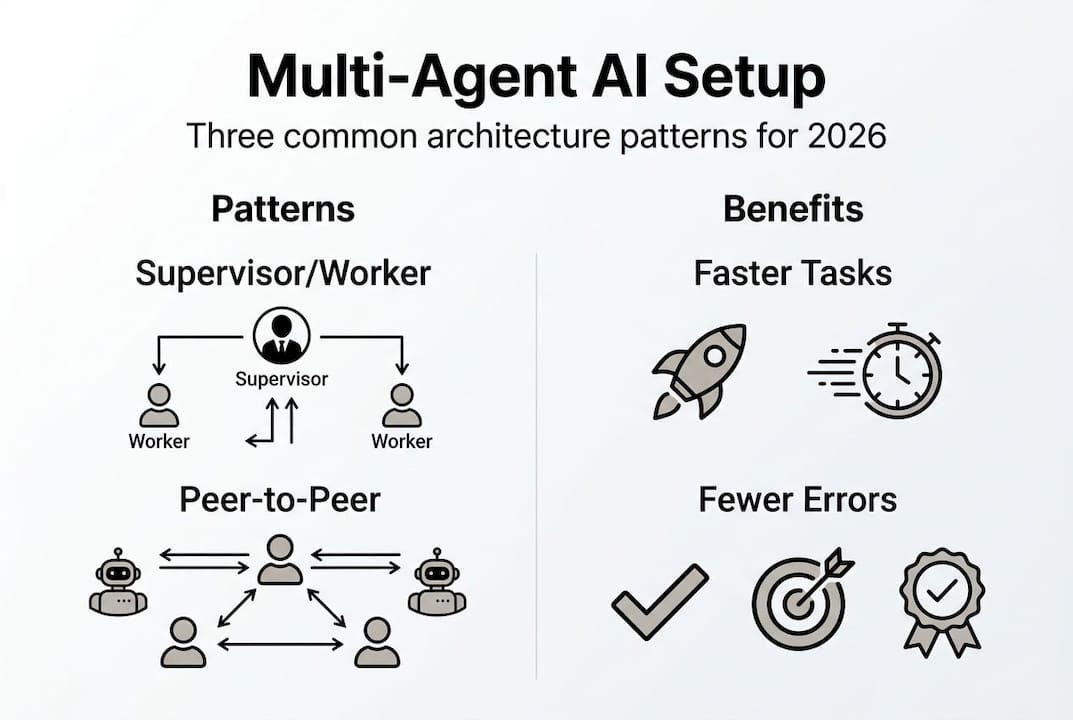
Why does this matter for your business? Because the productivity gap is enormous. Empirical benchmarks show 3-5x productivity gains and 30-80% time reduction in workflows that deploy multipurpose AI. And the market is moving fast. By 2028, over 50% of enterprises will abandon assistive AI entirely in favor of outcome-focused, multi-agent workflow platforms.
Here are the top workflow use cases where multipurpose AI delivers the most impact:
- Customer service: Auto-resolve inquiries, escalate edge cases, and log outcomes simultaneously
- Content creation: Research, draft, edit, and publish in a single coordinated pipeline
- Predictive maintenance: Monitor systems, flag anomalies, and schedule repairs without human triggers
- Financial reporting: Pull data, reconcile figures, flag discrepancies, and generate summaries
- Sales enablement: Qualify leads, personalize outreach, and update CRM records in real time
| Metric | Single-agent AI | Multipurpose AI |
|---|---|---|
| Task completion speed | Baseline | 3-5x faster |
| Accuracy rate | Moderate | 60% higher |
| Workflow time reduction | 0-10% | 30-80% |
| Scalability | Limited | High |
Understanding AI productivity basics helps frame why this architectural shift matters so much. If you want a broader view of how AI boosts business productivity, the case for moving beyond single-agent tools becomes even clearer.
Essential tools and architecture patterns for multipurpose AI
Choosing the right tools is where most teams either set themselves up for success or create expensive technical debt. The good news: a small set of proven platforms covers most business needs.
CrewAI is purpose-built for role-based agent collaboration. It lets you define agents with specific roles, goals, and backstories, making it ideal for content, research, and customer-facing workflows. LangGraph gives you fine-grained control over stateful, cyclical agent workflows. It is the right choice when your process involves loops, conditional branching, or complex decision trees. Kubernetes is not an AI tool itself, but it is the infrastructure backbone that lets you scale agent workloads reliably across cloud environments without downtime.
Five distinct multi-agent architecture patterns exist, each solving different types of workflow challenges. Matching your architecture to your actual business problem is critical.
| Architecture | Best for | Complexity |
|---|---|---|
| Supervisor/Worker | Task delegation, customer service | Low to medium |
| Hierarchical | Enterprise workflows, multi-department | High |
| Sequential/Pipeline | Linear processes, content pipelines | Low |
| Peer-to-peer | Research, collaborative drafting | Medium |
| Hybrid | Complex, multi-phase operations | Very high |
Here is a numbered setup path for your minimum viable prototype:
- Map your target workflow in detail. Identify every handoff point and decision node.
- Choose your architecture pattern based on the table above.
- Select your orchestration tool (CrewAI for role-based, LangGraph for stateful).
- Define agent roles, inputs, and outputs before writing a single line of code.
- Run a controlled pilot on one workflow with real but low-stakes data.
- Measure baseline versus post-deployment metrics before expanding.
When reviewing top AI models for business, prioritize models with strong API reliability and context window size. Following best AI practices from the start saves significant rework later.
Pro Tip: Audit your existing software licenses before adding new tools. Many businesses pay for overlapping capabilities across platforms. Consolidating to one orchestration layer often cuts licensing costs by 20-30% while simplifying your tech stack.
Laying the groundwork: security, compliance, and common setup pitfalls
Most multipurpose AI projects do not fail because the AI was bad. They fail because the team underestimated what happens between agents. Orchestration failures at handoff points, context overload when agents receive too much unstructured data, and unclear governance policies are the three most common culprits.
40% of agentic AI projects fail due to overlooked cost, value realignment, or governance compliance gaps. That is not a small risk. It is a coin flip.
"The risk isn't the AI model. It's the handoff, the governance gap, and the assumption that compliance can be retrofitted after launch."
Here are the security and compliance must-haves you need from day one:
- Data access controls: Define exactly which agents can access which data sources, and enforce it at the infrastructure level.
- Audit logging: Every agent action should be logged with timestamps, inputs, and outputs for traceability.
- Role-based permissions: Separate agent permissions from human user permissions. Never give an agent admin-level access by default.
- Data residency rules: Know where your data is processed and stored, especially if you operate across jurisdictions.
- Incident response plan: Define what happens when an agent produces a harmful or incorrect output before it reaches a customer or stakeholder.
Understanding AI security fundamentals is non-negotiable before you go live. Reviewing AI security frameworks gives you a structured approach to hardening your setup. For teams handling sensitive data, AI data privacy essentials covers the compliance layer in detail.

Pro Tip: Build a human-in-the-loop checkpoint into every agent workflow during your first 90 days. This is not a sign of distrust in the technology. It is a risk management strategy that catches edge cases before they become incidents, and it gives your team the confidence to scale faster afterward.
Measuring success and scaling your multipurpose AI
Deployment is not the finish line. The real work starts when you measure whether the system is actually delivering value and then use that data to scale intelligently.
Define success metrics before you launch, not after. For customer service workflows, track auto-resolution rate, average handling time, and customer satisfaction score. For content pipelines, measure output volume, revision cycles, and time-to-publish. For financial workflows, focus on error rates, reconciliation time, and reporting cycle length.
The numbers from real deployments are striking. Telecoms using multipurpose AI saw 73% of inquiries auto-resolved and a 75% reduction in handling time. Pharma companies observed 1-2% revenue lifts from agentic AI deployment. These are not edge cases. They are repeatable outcomes from well-structured implementations.
| Workflow area | Before AI | After multipurpose AI |
|---|---|---|
| Customer inquiry resolution | Manual, 8-12 min avg | 73% auto-resolved, 75% faster |
| Content production cycle | 5-7 days | 1-2 days |
| Financial reconciliation | 2-3 days | 4-6 hours |
| Revenue impact (pharma) | Baseline | 1-2% lift |
Here is how to move from pilot to organization-wide rollout:
- Validate pilot metrics against your pre-defined success criteria. If they are met, proceed. If not, diagnose the bottleneck first.
- Identify the next highest-value workflow using the same mapping process from your pilot.
- Replicate the architecture pattern that worked, adjusting agent roles for the new context.
- Train stakeholders in each department before expanding agent access to their workflows.
- Review bottleneck data monthly and adjust agent task assignments, not just model parameters.
When you hit a scaling bottleneck, the instinct is to add more agents. Often, the better fix is to add more functions to existing agents or improve the quality of data inputs. Reviewing AI productivity models helps you understand where model choice affects throughput. Understanding AI types for integration clarifies when to swap an agent's underlying model versus restructuring the workflow itself.
Why solving for orchestration and governance is more important than chasing model accuracy
Here is the uncomfortable truth most vendors will not tell you: the AI model is rarely the bottleneck. Teams spend months debating GPT-4o versus Claude 4.0 versus Gemini 2.5 while their workflows collapse at the handoff between agents, or their project stalls because no one defined who owns the output when something goes wrong.
Gartner emphasizes focusing AI initiatives on business model innovation through customer journey mapping and outcome-driven agent orchestration. That is the real differentiator. Not the model. The process around it.
We have seen this pattern repeatedly: organizations that invest in governance frameworks and clear orchestration logic outperform those chasing marginal accuracy gains on benchmark tests. The real-time AI advantages only materialize when the underlying workflow is designed for outcomes, not for demonstrations.
Pro Tip: Before your next AI planning session, replace the question "which model should we use?" with "what business outcome are we accountable for, and how does each agent handoff support that outcome?" That reframe alone will save you months of misdirected effort.
Get started with multipurpose AI simplified
You now have the architecture knowledge, the security checklist, and the scaling roadmap. The next step is putting it into practice without starting from scratch on your own.
Sofia's AI platform gives your team access to over 60 state-of-the-art AI models, including GPT-4o, Claude 4.0, and Gemini 2.5, all in one place. With built-in team collaboration tools, GDPR-compliant security, enterprise encryption, and custom AI profiles, Sofia is designed for exactly the kind of multipurpose, outcome-driven AI deployment this guide describes. Whether you are running a pilot or scaling across departments, Sofia removes the infrastructure complexity so your team can focus on results. Explore the platform, request a custom workflow review, or start your trial today.
Frequently asked questions
What is the key advantage of a multipurpose AI system over traditional single-agent AI?
Multipurpose AI uses multiple specialized agents working in coordination, which delivers 3x faster task completion and 60% better accuracy compared to single-agent approaches, along with far more flexible workflow coverage.
Which tools are best for setting up a multipurpose AI system?
CrewAI, LangGraph, and Kubernetes are the most widely used tools, chosen for their ability to support different agent architectures and scale reliably across enterprise environments.
How do I ensure security and compliance in my AI setup?
Implement data access controls, audit logging, and human supervision checkpoints from day one. Governance compliance gaps are among the top reasons agentic AI projects fail, so treat security as a launch requirement, not an afterthought.
What are common causes of failure in multipurpose AI projects?
40% of agentic AI projects fail due to poor orchestration at handoff points, unclear governance, and underestimated costs. The AI model itself is rarely the root cause.
What results can businesses expect from a well-implemented multipurpose AI setup?
Businesses have achieved 3-5x productivity gains and 30-80% time savings, with specific industries like telecom seeing 73% auto-resolution rates and pharma recording measurable revenue lifts.